




How Arteta transformed Arsenal into Premier League champions after 22 years
Arsenal’s long-awaited return to the summit of English football was about far more than lifting the Premier League trophy.
Behind the title triumph that ended a 22-year wait lay a painstaking rebuild driven by culture, patience, leadership and a renewed bond between the club and its supporters, according to an in-depth account published by Arsenal.
On Friday, the club’s official behind-the-scenes feature chronicles how manager Mikel Arteta, club owners Stan and Josh Kroenke, sporting director Andrea Berta, players and supporters collectively engineered one of the most significant transformations in Arsenal’s modern history.
For Arteta, finally seeing Arsenal crowned champions surpassed even the vision he had carried for years.
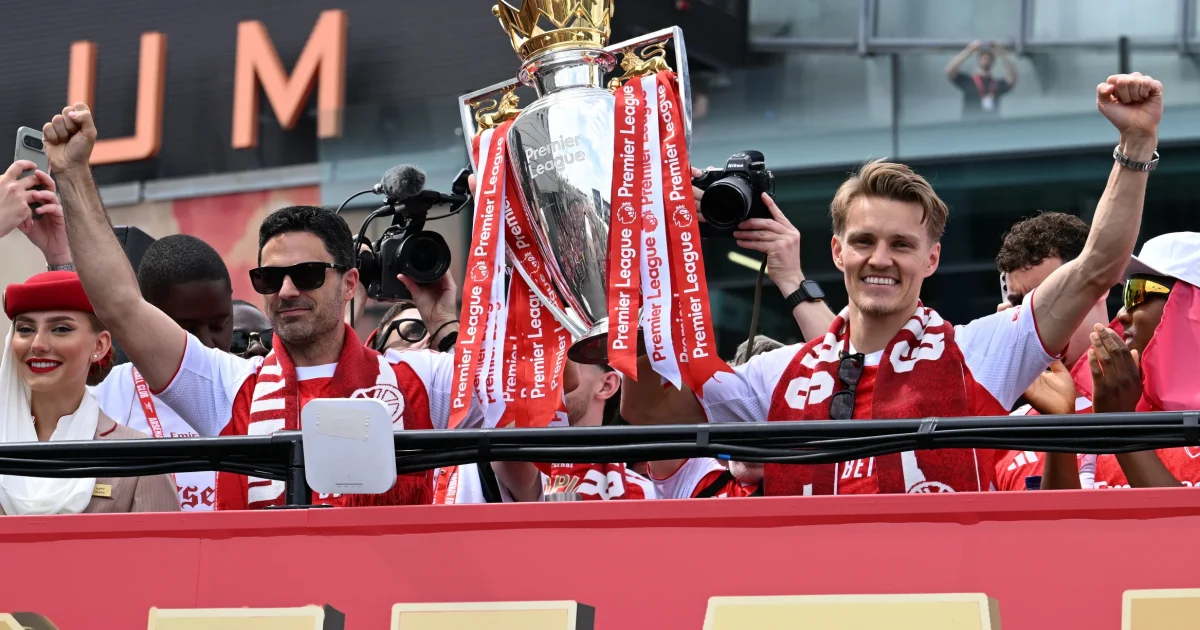
The Spaniard recalled while reflecting on the moment captain Martin Ødegaard lifted the Premier League trophy, “It was much better.
“I was just looking at the players’ faces, how much it means to them, and to see them gathering together and lifting it. It was incredible.”
The triumph sparked unprecedented celebrations across North London and beyond.
Around one million supporters flooded Islington during the title parade, while celebrations spread across continents—from Uganda and Kenya to India, China, Australia, Ethiopia and Nigeria—illustrating Arsenal’s global reach.
The club described the celebrations as something that transcended football.
“It felt like a social phenomenon,” the feature noted, documenting scenes ranging from fans climbing trees in London to a church bishop in Lagos leading his congregation in songs celebrating Arsenal’s title victory.
Crystal Palace forward Eberechi Eze, who joined Arsenal during the title-winning season, described the achievement as something much bigger than winning football matches.
He said, “There are no words to describe this thing properly, what we’re feeling, what we’re going through, what this moment means.
“This isn’t just about winning the title as a group of players. This is about something that represents an area, represents values, represents people’s dreams… Arsenal is the culture club.”
The club credits much of that transformation to Arteta’s emphasis on rebuilding Arsenal’s identity after taking charge in 2019.
Co-chair Josh Kroenke said discussions with the former midfielder during the recruitment process centred less on tactics and more on culture.
Kroenke said, “When the time came to hire Mikel, the entire conversation we had with him was about culture and reinventing that.
“You could see him lock in. He had done his homework… and he understood there was a big task ahead of him.”
That philosophy also shaped Arsenal’s transfer strategy.
Sporting director Andrea Berta revealed that while improving the squad technically remained important, strengthening its character came first.
“During the summer transfer window, a focus we both had, Mikel and I, was to improve the team technically. But first we wanted to improve it humanly, because for us, the group, its integrity and its maturity was the most important aspect.”
Captain Martin Ødegaard said new arrivals immediately felt the culture inside the club.
“We really care for each other. We really help each other. We fight for each other. We give everything, every single day, for each other,” he said.
On the pitch, Arsenal’s success rested on defensive solidity, squad depth and decisive contributions across the team.
The feature highlights goalkeeper David Raya, defenders William Saliba and Gabriel Magalhães, midfielder Declan Rice and several match-winning moments from across the squad as the foundation of the title-winning campaign.
But equally important, the club argues, was maintaining belief during difficult periods.
Following defeats and growing scrutiny, Arteta repeatedly urged unity and optimism.
“Jump in this boat,” he told supporters. “It is going to be fun. A lot of incredible things are going to emerge.”
The defining stretch came during the closing weeks of the campaign, when Arsenal stayed in the title race despite setbacks before finally clinching the championship after Manchester City’s slip at Bournemouth.
Declan Rice’s words after defeat to City—”It’s not done”—became a rallying cry inside the club.
Andrea Berta said everyone shared that conviction.
“We never lacked the conviction that this was and would be our season,” he said.
Reflecting on the achievement, Arsenal concludes that the title was the product of years of persistence rather than a single successful season.
According to the club, Arsenal won the league by trusting a long-term process, strengthening relationships between ownership, management, players and supporters, reconnecting with its history and building a culture in which everyone felt they belonged.
“They won by unity, with everyone playing their part to the best of their ability,” the feature said, describing the triumph as the culmination of a collective effort that transformed both the club and its supporters.
All images credit: Arsenal website
All rights reserved. This material, and other digital content on this website, may not be reproduced, published, broadcast, rewritten or redistributed in whole or in part without prior express written permission from PUNCH.
Contact: [email protected]
Stay informed and ahead of the curve! Follow The Punch Newspaper on WhatsApp for real-time updates, breaking news, and exclusive content. Don’t miss a headline – join now!
Stay in the know—fast. Get instant alerts, breaking headlines, and exclusive stories with the Punch News App. Download now and never miss a beat.
Source: Punch Newspapers – Latest News