








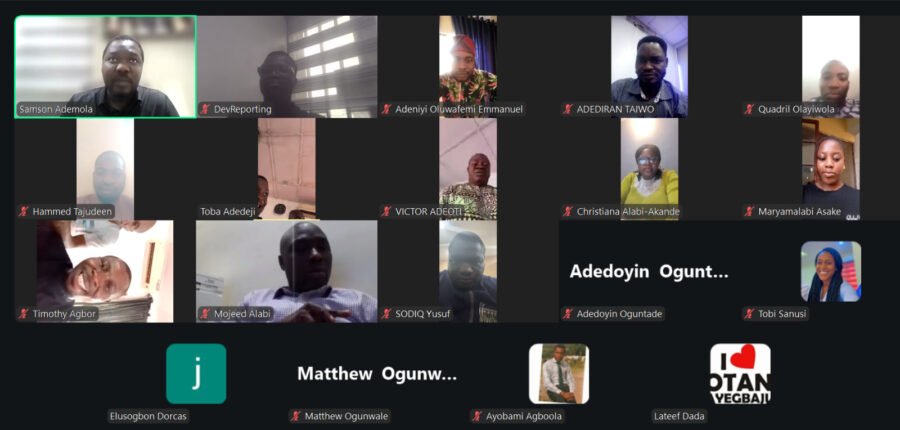
DevReporting on Thursday trained 23 journalists from across Osun State, equipping them with practical tools to investigate governance and accountability issues, refine story ideas, and produce compelling, evidence-based, human-centred reports.
The Local Governance Reporting Project is being implemented by DevReporting in partnership with the Centre for Journalism Innovation and Development (CJID) through its Local Media Sustainability Fund (LMSF), with support from the Royal Norwegian Embassy.
The journalists emerged from a competitive selection process that attracted 62 applications from across Osun State. Of the applicants, 53 (85.5 per cent) were male while nine (14.5 per cent) were female.
The training, which was held virtually, was designed to strengthen participants’ investigative and accountability reporting skills ahead of the reporting phase.
Related Posts:
Speaking at the opening of the training, DevReporting Programme Manager and Associate Editor, Samson Ademola, congratulated participants on their selection and said the training would expose them to practical investigative reporting techniques and the project’s operational framework.
Journalism’s role is to hold power accountable
Delivering a goodwill message, CJID Programme Officer, Sefa Ikpa, urged participants to rethink the purpose of journalism, stressing that the media remains one of democracy’s strongest accountability institutions when public systems fail.
She said democracy thrives when journalists focus on issues affecting citizens rather than limiting coverage to routine political activities.
“When institutions fail, citizens depend on the media. That is why journalists are one of the most important institutions for engendering accountability.”
Ms Ikpa said the project provides reporters with an opportunity to immerse themselves in communities, understand citizens’ realities and produce stories capable of influencing governance outcomes.
“At CJID, we believe democracy gets better when journalists report issues that matter to democracy, development and accountability. Why are you a journalist? I hope that at the end of this training, you will be able to answer that question for yourself, for democracy and for the nation,” she said.
Journalists urged to follow public funds
Facilitating a session on ‘Leveraging Multimedia to Tell Compelling Investigative Stories, DevReporting Senior Multimedia Strategist, Bukola Adebayo challenged participants to move beyond event reporting by tracing how public resources are spent within their communities.
She encouraged journalists to investigate whether publicly funded projects have delivered the benefits promised to citizens.
She urged participants to engage local government officials, traditional rulers, market women, religious leaders and residents while asking difficult questions about abandoned, delayed or poorly executed projects.
Drawing attention to governance gaps across Osun communities, she cited neglected primary healthcare centres, dilapidated schools, poor road infrastructure, abandoned markets lacking sanitation facilities and commissioned projects left non-functional.
“If you don’t report such issues, who will report them better?” she asked, urging participants to amplify community voices and investigate the human impact of governance failures.
Mrs Adebayo stressed that investigative journalism is built on evidence, verification and sustained reporting rather than isolated stories. She encouraged journalists to document their findings with photographs and videos during field investigations, corroborate major claims through independent sources and verify statistical data before publication.
“You can’t say that you are doing an investigation without taking pictures and videos for evidence,” she said.
The multimedia expert also urged participants to specialise in sectors such as education, health and public infrastructure, noting that sustained reporting on a particular issue often attracts wider attention and prompts policy action.
Highlighting practical investigative skills participants would acquire during the project, Mrs Adebayo listed hypothesis building, source development, document verification, interviewing techniques and multimedia storytelling.
Look beyond political noise
DevReporting Team Lead and Editor-in-Chief, Mojeed Alabi, who facilitated a session titled ‘Investigating Local Issues: Finding Stories Beyond Politics’, urged participants to shift their attention from political controversies to the everyday realities affecting citizens.
“Journalism is not a profession; it is a calling,” he said.
Although political disputes often dominate headlines, Mr Alabi said reporters should investigate how governance failures affect healthcare, education, infrastructure, livelihoods and community development.
“If we report only the political tussle and leave the story halfway, we miss the real story.”
He encouraged participants to investigate public allocations, budget implementation and project execution using Freedom of Information (FoI) requests, public records, routine field monitoring, digital footprints and reliable community networks.
He added that impactful journalism not only exposes governance failures but also documents practical community responses capable of informing solutions.
Accountability begins with journalists
The Managing Editor, DevReporting, Christianah Alabi-Akande, challenged participants to rethink their approach to developing accountability stories, stressing that journalists must hold themselves to the same standards of accountability they expect from public officials.
“Accountability is not a yardstick for government workers alone; it is also a concern for journalists. We must be accountable as well,” she said.
She urged participants to ask a fundamental question before pursuing any investigation: “Why should a funder invest in my story? Is my story fundable?”
She said many promising story ideas fail to secure funding because their pitches do not clearly explain why the investigation matters or demonstrate the potential for public impact and accountability.
“Funders don’t simply fund stories, they fund journalists who have a clear reporting pathway from idea to impact,” she said.
Mrs Alabi-Akande said successful pitches should clearly define the problem, explain its significance, identify those affected, present available evidence, outline the reporting approach and state the accountability outcomes the investigation seeks to achieve.
“Evidence is what gives your story authority. Opinion alone cannot sustain an accountability story; evidence gives it credibility. It transforms allegations into findings,” she said.
She also encouraged journalists to incorporate solutions journalism by highlighting interventions that have worked elsewhere and could be adapted by other communities or states.
The training concluded with breakout sessions during which participants worked in groups to develop accountability story ideas. Each group refined its pitches before presenting them to facilitators for editorial feedback ahead of the reporting phase.
Following the training, participants will submit accountability story pitches for editorial consideration. Selected investigations will receive reporting grants to support fieldwork, alongside editorial mentorship throughout the reporting process.
Author
-
Sodiq Mojibola is a Nigerian-based multimedia journalist. He has experience covering metro and environment beats.
Source: Development Reporting