










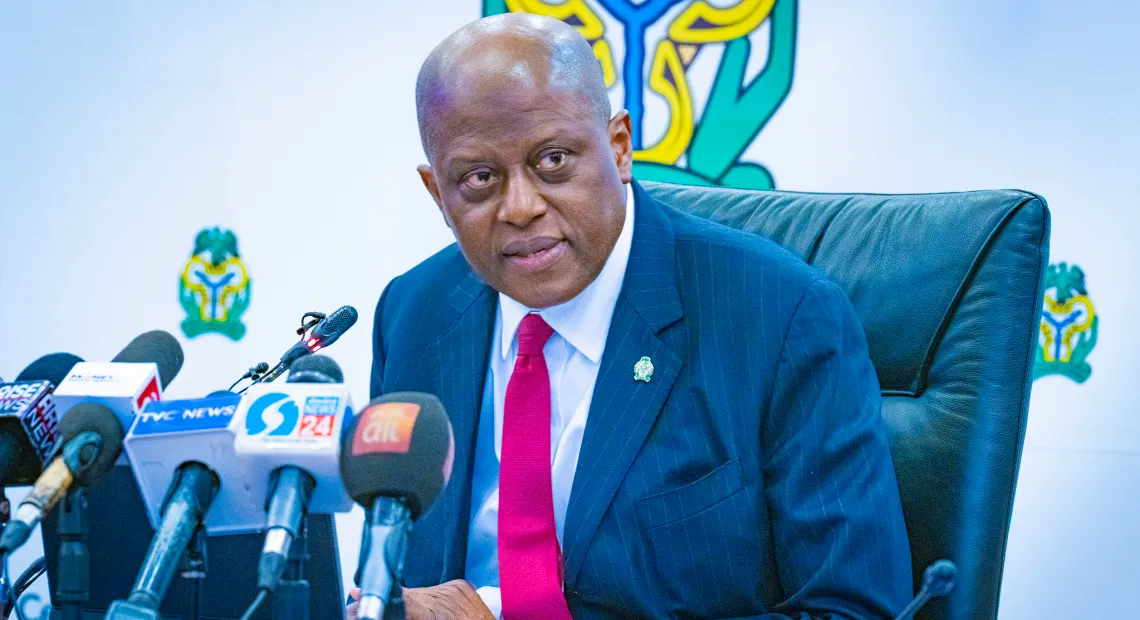
The country’s net external reserves, which stood at about $3 billion, when the current management of the Central Bank of Nigeria (CBN) assumed office in October 2023, have now risen above $40 billion, the apex bank Governor, Olayemi Cardoso, has said.
Cardoso, who disclosed this at the BusinessDay CEO Forum held in Lagos on Thursday, noted that the increase in net reserves was evidence of the positive results of the reforms embarked upon by the CBN, which were aimed at restoring stability to the foreign exchange market.
According to him, the reforms have also resulted in the gross external reserves rising to about $52 billion as of Wednesday, July 15, 2026.
“When we started, the net exchange reserves figure was in the region of about $3 billion-plus. And if you remember, that was a figure that was published at the time by J.P. Morgan and created a lot of panic in the system. More recently, our net reserves figure is in the forties,” Cardoso said.
He further announced that the CBN expects to meet its target of achieving $1 billion monthly diaspora remittances by the end of 2026. He disclosed that formal diaspora remittances inflows have already tripled from about $200 million to $600 million per month as a result of ongoing forex reforms.
Cardoso emphasised that the positive results of the forex reforms have not only resulted in restoring stability as well as boosting liquidity in the forex market, but that they have also restored confidence in the Nigerian economy and strengthened the country’s external position.
He urged business leaders to leverage the improved macroeconomic environment and position themselves for the next phase of economic growth.
He expressed optimism that the progress achieved so far would encourage businesses and investors to commit more capital to the Nigerian economy.
“So, in a nutshell, I do believe that where we are now, we’ve achieved that hard-earned stability, and with stability comes potential for investment, and with investment comes growth, and all our local CEOs should be part and parcel of that train that is moving,” Cardoso said.
Commenting on expectations regarding the outcome of next week’s Monetary Policy Committee (MPC) meeting, the CBN Governor said that while the gradual slowdown in inflation has opened the door to interest-rate cuts, external shocks have complicated the apex bank’s outlook on inflation.
He cited the 11 consecutive months of disinflation, before the Middle East conflict triggered global inflation, as evidence that the central bank’s tightening campaign was producing the desired result.
“There were 11 months of continuous disinflation,” he said, adding that the trend had strengthened expectations that “over a period of time, we would expect interest rates to begin to moderate.”
“If not for the fact that we had this (Iran war), we had projected that going into next year inflation would have been down to very moderate levels,” he said.
Cardoso defended the MPC’s decision to hold rates at its last meeting, despite market expectations of a rate cut. He said: “We didn’t cut, and believe me, we saw things that most other people didn’t see.”
He said the MPC would remain guided strictly by data ratherthan market sentiment, and credited the early implementation of economic reforms with helping Nigeria withstand recent global shocks.
“One of the reasons for that is the fact thatwe had undertaken the reforms a lot earlier,” Cardoso said, adding that: “We had resilience and we were able to withstand the shocks.”
Speaking earlier at the event, which had as its theme, “From stability to shared prosperity,” the Minister of Finance and Coordinating Minister of the Economy, Taiwo Oyedele, announced that the Federal Government plans to publish indicators tracking poverty, incomes and inequality.
He said the FG would assess “shared prosperity” using three measures: reductions in multidimensional poverty, increases in real income per capita and lower inequality.
Oyedele, who noted that the government’s reforms were yielding results as inflation was easing, the foreign exchange market was functioning more efficiently and investor interest was returning, however, acknowledged that macroeconomic stability alone would not be enough.
“A stable economy can still be a stagnant one if we become complacent,” he said.