






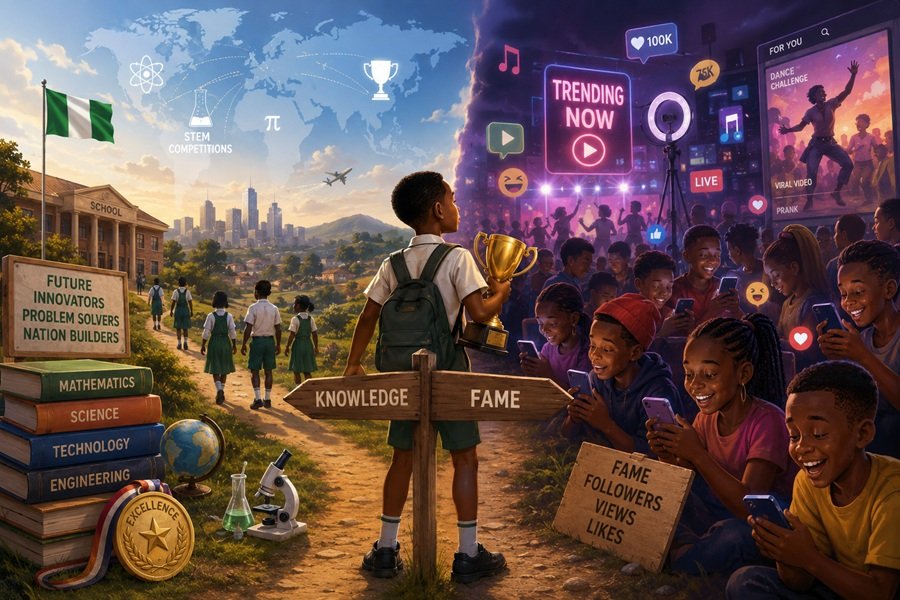
As the “Olodo Uprising” debate captivated social media, Nigerian students quietly returned home with global honours in mathematics and science. This feature explores what that contrast reveals about Nigeria’s attention economy, investment in education and the values shaping what and who the country chooses to celebrate.
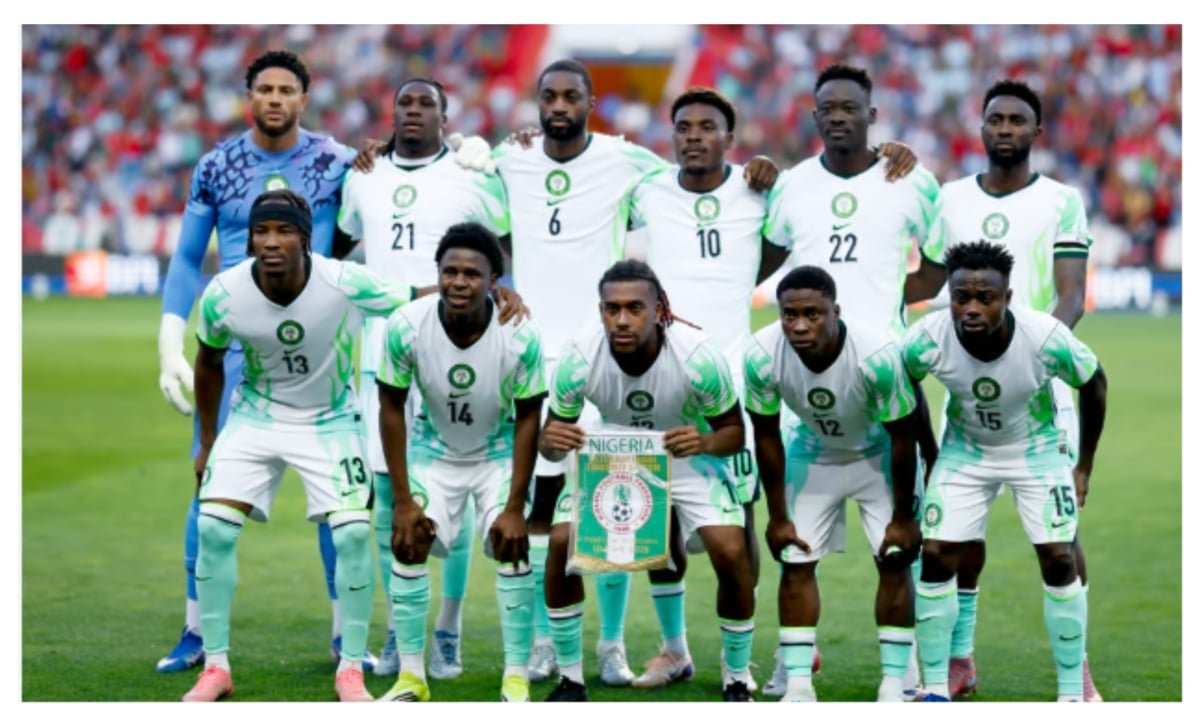
Chimdiebube Onwubiko, Don Munachimso and Egejurum Onyedikachi represented Nigeria at the 2026 International STEM Olympiad, competing against students from over 150 countries.
The trio qualified to represent Nigeria after emerging among the best contestants at the Southeast Mathematics Olympaid, a competition that attracted over 11,500 participants from across the region.
Related Posts:
- FULL TEXT: Dapo Olorunyomi’s lecture at Ajayi Crowther University on Nigerian journalism
- From Borno to Oriire: 2,573 abducted in 31 violent Nigerian school attacks over 12 years
- Theatre of War and The World Economic Order; Wither Nigeria – By Ige Asemudara
- BREAKING: NECO releases 2025 SSCE results, records 60% pass
Munachimso won gold in both mathematics and science. Eleven-year-old Onyedikachi in Primary six was named the world’s best in mathematics at primary level. Onwubiko, 13, clinched gold medal in mathematics category for grade 9, 10, and 11.
Also at the same competition, 16 students from The Ambassadors Schools in Ogun State added to Nigeria’s tally at the same competition, winning 15 gold medals, nine silver and nine bronze and one honourable mention, according to the school.
The Chief Executive of Officer (CEO) of Educare and founder of Southeast Mathematics Olympaid, Alex Onyia, who sponsored the first three students, said over 30,000 have already registered for next year’s edition of the qualifying regional competition.
Their mathematics teachers, Chisom Unachukwu of Evergreen Schools in Enugu and Anthony Iwegbu of Diamond Special College in Owerri, trained them before travelling with them to Rome.
While those celebrations were still unfolding, rapper Ycee ignited a national conversation on the Afropolitan Podcast. He argued that Nigeria had entered what he called an ‘Olodo Uprising’, an era in which academic excellence no longer commands the admiration it once did. According to him, a new culture that rewards visibility over substance is gradually replacing one that celebrates intellectual achievement. He cited TikTok streamer Peller as an example of that shift.
At almost the same time, two very different stories competed for Nigerians’ attention. One celebrated children flying the country’s flag on the global stage through academic excellence. The other centred on a rapper’s controversial diagnosis of the country’s changing values. While the students’ achievements received brief applause, the “Olodo Uprising” debate sparked weeks of conversation across social media.
How the debate began
Ycee did not set out to criticise anyone personally. His comment came during a broader conversation on the Afropolitan Podcast about music, fame and changing social values. He argued that Nigeria had moved from what he described as a “Yahoo culture,” built around internet fraud, to a culture driven by clout, online attention and streaming.
To explain his point, he cited TikTok streamer Peller as an example. Despite having little formal education, Peller commands millions of followers and reportedly earns more than many university graduates.
In his words, “We now have an Olodo uprising, and it’s terrible. It’s like we’re trying to accommodate unintelligent and ignorant people because we don’t want them to feel bad, so now they are becoming the majority. There is a massive attack on the educational system in Nigeria. Society is no longer celebrating academic excellence. People don’t even want to go to school anymore. Now, it isn’t just the Yahoo culture; we also have the Peller culture.”
Ycee acknowledged that he was not an outstanding student himself, but said the discipline and work ethic he developed through schooling later helped him succeed in music.
In his exact words, “I dey like 200 level, carryover wan carry me. It reached a point where I was no longer comfortable in school because the attention was getting too much. If I had finished from UNILAG, I for don go do another thing.” Before he later credited the grunt of academic work to his eventual success in music. “I wasn’t an outstanding student, but school taught me discipline and consistency. Those habits helped me stay focused and build a career in music,” he said.
Peller rejected the characterisation, saying he had been unfairly singled out to represent a broader societal problem. His fiancée, Jarvis, who is a university graduate, argued that content creation has become one of the few viable career paths for many educated young Nigerians struggling to find jobs. The debate intensified after Peller advertised a personal photographer position with a monthly salary of ₦500,000 and mocked some of the applicants, including master’s degree holders, who applied for the role.
As the conversation gained momentum, other personalities became part of the debate. Comedian and content creator Carter Efe shared a certificate claiming he graduated with a First Class degree from Babcock University.
The university, however, disputed the document, saying it neither issued the certificate nor recognised the classification it displayed. The incident further fuelled discussions about whether educational credentials are increasingly being used as social media props.
Ycee later clarified that his comments were aimed at a culture rather than any individual. By then, however, the phrase “Olodo Uprising” had taken on a life of its own, evolving into one of the country’s most talked-about social debates.
Long before “Olodo Uprising”
Before social media influencers became household names, Nigeria had established platforms that celebrated academic excellence.
Competitions such as the Cowbell National Secondary Schools Mathematics Competition; the Nigerian National Petroleum Company Science Quiz Competition; the Junior Engineers, Technicians and Scientists (JETS) Competition, and the National Mathematics Centre’s Olympiad among others have, for decades, identified and rewarded some of the country’s brightest young minds.
While those competitions and others continue to produce outstanding students, they now compete for public attention in a digital landscape dominated by entertainment and online creators.
Where the attention actually goes
If Ycee’s argument is that Nigerians increasingly reward visibility over knowledge, TikTok itself offers an interesting test of that claim.
In February 2025, the platform launched a dedicated science, technology, engineering and mathematics (STEM) feed across more than 20 African countries, including Nigeria. Separate from the main For You page and Following tabs, the feed was designed to promote STEM content. Every video on the feed is reviewed by two independent organisations, Common Sense Networks and the Poynter Institute, before it reaches users.
The feature is automatically enabled for teenagers aged 13 to 18, although any user can choose to switch it off. TikTok says about one-third of teenagers in the United States visit the STEM feed every week, a figure it cites as evidence that there is an appetite for educational content when it is made easily accessible.
The STEM feed has received little public attention in Nigeria. Instead, much of the conversation on TikTok continues to revolve around livestreams, dance videos and creator banter, the kind of content Ycee argued now dominates the country’s digital culture. The opportunity to learn sits alongside the opportunity to be entertained, but entertainment often attracts the larger audience.
The difference is not just in what people choose to watch. Social media algorithms are also designed to push content that keeps users engaged, making it harder for a video explaining a chemistry concept to compete with a livestream where thousands of viewers are reacting, commenting and sending virtual gifts in real time.
That contrast is visible across the platform. TikTok, with more than a billion monthly users worldwide, hosts educators such as Nigerian science teacher, Aisha Bande, who simplifies science lessons for the STEM feed. Yet those videos attract only a fraction of the attention generated by popular livestreams and entertainment creators.
The same pattern extends beyond social media. Big Brother Naija illustrates the scale of the country’s appetite for entertainment. Its last season attracted 1.53 billion votes from viewers across 49 African countries. Season 11, scheduled to premiere on 26 July, will feature the show’s largest cast yet and a grand prize of more than ₦150 million.
Since its debut in 2006, the reality show has become what organisers describe as one of Africa’s biggest entertainment brands, generating levels of public attention that no academic competition in Nigeria has come close to matching in audience engagement, prize money or everyday conversation.
What funding says about priorities
While one private citizen paid to send Nigerian students to Rome, questions remain about how much public investment exists for gifted education.
The debate over whether Nigeria still values academic excellence extends beyond social media. It is reflected in how the country funds education and supports its brightest students.
Although Nigeria’s education budget has increased over the years, many stakeholders argue that investment in the sector remains inadequate. Under the Education 2030 Framework for Action, the United Nations Educational, Scientific and Cultural Organisation (UNESCO) recommends that governments allocate at least 15 to 20 per cent of their total annual public expenditure to education or at least four to six per of the national Gross Domestic Product (GDP) to the sector.
The Minister of Education, Tunji Alausa, recently echoed similar concerns, saying government spending on education has consistently remained below global standards, limiting infrastructure development, research and access to higher education. According to him, federal budgetary allocations to the sector have historically ranged between five and eight per cent, far below UNESCO’s recommended benchmark.
What a nation chooses to fund
Development economist and public policy expert, Samuel Nwaefor believes Nigeria’s education spending reflects a deeper problem than budget figures alone.
“The budget tells you where a country’s heart is,” he said. “And Nigeria’s heart is clearly not in education.”
According to him, Nigeria currently spends between six and seven per cent of its national budget on education, compared with about 12 per cent in Egypt, nine per cent in South Africa and eight per cent in Kenya according to World Bank data.
For Mr Nwaefor, a visiting lecturer at the Osun State Polytechnic, countries that deliberately invested in education built the economies that now compete globally.
He said, “South Korea, once as poor as many African countries at independence, now spends close to six per cent of its GDP on education and has a per capita GDP of more than $33,000. Singapore also built its transformation from the 1960s through sustained investment in schools, technical institutes and universities. Today, it ranks among the world’s wealthiest countries, with more than three-quarters of its population passing through some form of post-secondary education.”
To him, the contrast demonstrates that what a nation consistently funds ultimately shapes what it becomes.
“A country that invests more attention and resources in entertainment than education may produce citizens who are good at consuming content but are less equipped to build the industries, institutions and technologies that drive long-term economic growth,” he said.
Mr Nwaefor argues that Nigeria’s relationship with academic excellence was not always this way. He recalled a time when knowledge-based programmes commanded national attention and celebrated intellectual achievement.
“Cowbellpedia produced Faith Odunsi, who solved 18 mathematics questions in 60 seconds before earning a scholarship worth more than $400,000 to study at the Massachusetts Institute of Technology. ‘Who Wants to Be a Millionaire?’ also made Aroma Ufodike a household name after he became the first contestant to win the programme’s ₦10 million grand prize in 2009. At the time, answering difficult questions correctly was something millions of Nigerians tuned in to celebrate.”
He believes today’s media landscape tells a different story.
“Those programmes have largely given way to formats driven by votes, drama and streaming numbers rather than knowledge and scholarships.” That shift in what Nigeria chooses to fund and celebrate, according to him, is more than a cultural change.
“It is a signal of national direction, the same signal that separated countries like South Korea and Singapore from nations still trying to build schools with money left over after paying salaries.”
What a nation chooses to fund
Development economist and public policy expert, Samuel Nwaefor believes Nigeria’s education spending reflects a deeper problem than budget figures alone.
“The budget tells you where a country’s heart is,” he said. “And Nigeria’s heart is clearly not in education.”
According to him, Nigeria currently spends between six and seven per cent of its national budget on education, compared with about 12 per cent in Egypt, nine per cent in South Africa and eight per cent in Kenya according to World Bank data.
For Mr Nwaefor, a visiting lecturer at the Osun State Polytechnic, countries that deliberately invested in education built the economies that now compete globally.
He said, “South Korea, once as poor as many African countries at independence, now spends close to six per cent of its GDP on education and has a per capita GDP of more than $33,000. Singapore also built its transformation from the 1960s through sustained investment in schools, technical institutes and universities. Today, it ranks among the world’s wealthiest countries, with more than three-quarters of its population passing through some form of post-secondary education.”
To him, the contrast demonstrates that what a nation consistently funds ultimately shapes what it becomes.
“A country that invests more attention and resources in entertainment than education may produce citizens who are good at consuming content but are less equipped to build the industries, institutions and technologies that drive long-term economic growth,” he said.
Mr Nwaefor argues that Nigeria’s relationship with academic excellence was not always this way. He recalled a time when knowledge-based programmes commanded national attention and celebrated intellectual achievement.
“Cowbellpedia produced Faith Odunsi, who solved 18 mathematics questions in 60 seconds before earning a scholarship worth more than $400,000 to study at the Massachusetts Institute of Technology. ‘Who Wants to Be a Millionaire?’ also made Aroma Ufodike a household name after he became the first contestant to win the programme’s ₦10 million grand prize in 2009. At the time, answering difficult questions correctly was something millions of Nigerians tuned in to celebrate.”
He believes today’s media landscape tells a different story.
“Those programmes have largely given way to formats driven by votes, drama and streaming numbers rather than knowledge and scholarships.” That shift in what Nigeria chooses to fund and celebrate, according to him, is more than a cultural change.
“It is a signal of national direction, the same signal that separated countries like South Korea and Singapore from nations still trying to build schools with money left over after paying salaries.”
The cost of neglect
An educationist, Afeez AbdulRasak said the “Olodo Uprising” debate and the limited attention given to Nigerian students excelling in international competitions are “a consequence of what we started a very long time ago.”
According to him, the issue goes far beyond social media or content creation. Rather, it reflects years of neglect that have steadily weakened the country’s education system and diminished the value attached to academic excellence.
Mr AbdulRasak who is founder of Child Expert Clinic argued that “no nation is going to rise above the quality of its teachers,” yet education has never truly been a priority for successive governments.
He said funding for the sector remains poor and continues to fall short of global standards. “Some Nigerians are going through a process of miseducation,” he said, explaining that the country has failed to prioritise education in ways that reward excellence or encourage outstanding achievement.
That neglect, according, is evident in the conditions under which teachers work. He said many teachers live in poor conditions, remain among the least-paid public servants and lack the resources needed to align with global best practices. He also pointed to the growing inequality in the education system, arguing that access to quality learning increasingly depends on a family’s financial capacity.
“For children to get the most amazing quality education, their parents have to make remarkable investments,” he said, adding that the government has failed to position education in a way that inspires public confidence and appreciation.
He also lamented what he described as a shift in what Nigerians choose to celebrate. Recalling programmes such as Cowbellpedia and Who Wants to Be a Millionaire?, he said knowledge and intellectual achievement once attracted greater public admiration. Today, however, he believes entertainment dominates the national conversation.
“What do we celebrate? We celebrate Big Brother Naija winners. We celebrate people who are entertainers,” he said. “Nigerians feel that one of the ways to be successful is to align with entertainment, forgetting that the future of our nation rests on education.”
For Mr AbdulRasak, reversing that trend will require more than criticism of social media. “The government needs to do better. Parents need to be role models to their children to appreciate education. As a community, we also need to celebrate education,” he said.
He argued that a society where it is easier to celebrate a Big Brother Naija winner than a student who wins a global STEM competition reflects a deeper national challenge. “It’s not a problem that is going to end anytime soon. It requires policy change. It requires a psychological shift. It requires intentionality. It requires evaluation. It requires a new scope of operation.”
The other side of the debate
Nollywood filmmaker, Sunny Okonkwo believes the disagreement between Ycee and Peller overlooks a deeper problem. According to him, Nigeria’s education system is already under immense pressure, with millions of children out of school and graduate unemployment remaining high. In his view, content creators should not be blamed for responding to the kind of content audiences choose to consume.
A State of the Nigerian Youth Report 2025 highlights that about 1.7 million graduates leave Nigeria’s universities and polytechnics every year, but the economy lacks the capacity to absorb them into the labour market.
According to the National Bureau of Statistics (NBS) November 2024 report, youth unemployment and underemployment remain critical challenges, with millions trapped in informal and unstable jobs that offer little income security.
“Nigeria has a real education challenge,” he said, adding that while digital platforms have created new economic opportunities, the country must not lose its respect for knowledge and learning.
A media personality, Daddy Freeze offered a different perspective. He argued that Peller merely took advantage of a system that had been failing long before his rise to fame and should not be blamed for the declining value attached to education. To illustrate his point, he cited a friend, a paediatric cardiologist, who earns less than ₦700,000 a month, saying a university degree no longer guarantees the financial stability it once promised.
Comedian and content creator Nasboi also defended the role of digital platforms. While reaffirming his belief in formal education, he argued that the internet has created opportunities that conventional employment has failed to provide.
Rather than criticising creators like Peller, he said, society should recognise how they have built successful careers and businesses from limited resources without dismissing the importance of education.
What began as a podcast conversation has grown into a broader discussion about education, public investment, entertainment and public attention, raising a larger question about what and who Nigeria chooses to celebrate as its students continue to record achievements on the global stage.
Source: Development Reporting